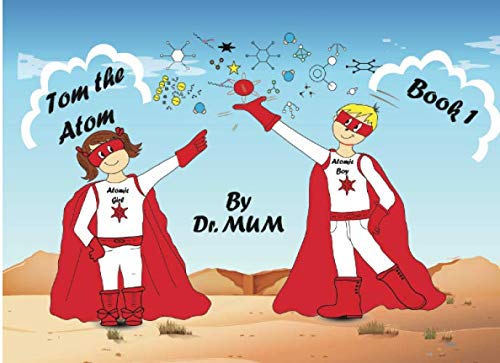
Tom the Atom is the core character of the series—specifically a Carbon atom from the Non-Metals family. He serves as the reader’s guide, introducing his atomic “family” members and explaining how elements interact to form the world around us.
The series spans multiple books organized by learning level. It begins with basic concepts like atom structures and covalent bonds, moving toward advanced topics like electronegativity, semiconductors, and radioactivity.
Absolutely. The series is specifically designed for both home-schooling environments and elementary or middle school classrooms, complete with clear learning outcomes and curriculum alignments for educators.
Yes. Each book explicitly outlines core learning objectives and key scientific concepts on its summary page, helping parents and teachers track comprehension as students progress through the series.
Tom the Atom is an educational children’s science book series created by Dr. MUM (Dr. Mirna Urquidi-Macdonald). It simplifies complex chemistry and physics concepts—like atoms, molecules, and the periodic table—into fun, illustrated stories for young readers.
Dr. MUM is a Professor Emeritus of Engineering at Penn State University. She wrote the series to foster early scientific curiosity, keen observation skills, and a lifelong love of STEM in children through engaging storytelling.
The series aligns with all the STANDARDS adopted by the 50 US states. There are three main standards (please use this word STANDARD instead of CURRICULUM). 20 states adopted Next Generation Science Standards (NGSS); Florida modified that standard and produced the Next Generation Science Standards and produced the Next Generation Sunshine State Standard (NSGSS); and 24 States adopted the Framework or DCI-Based Standards (here referred as Framework), Texas, and Puerto Rico has their own standards that are not included in our analysis.
Schools, libraries, and educational groups can contact us directly through our Contact page or call our customer support line to discuss institutional pricing and bulk ordering options.
Each book introduces atoms as characters with unique personalities and features. By visualizing chemical elements, covalent bonds, and subatomic behavior, children absorb foundational science effortlessly.
The series aligns with all the STANDARDS adopted by the 50 US states. There are three main standards (please use this word STANDARD instead of CURRICULUM). 20 states adopted Next Generation Science Standards (NGSS); Florida modified that standard and produced the Next Generation Science Standards and produced the Next Generation Sunshine State Standard (NSGSS); and 24 States adopted the Framework or DCI-Based Standards (here referred as Framework), Texas, and Puerto Rico has their own standards that are not included in our analysis.